






In a year dominated by COVID-19 news, several local news stories stood out for their impact on the community and its residents.
In fact, COVID-19 news accounted for our three of our top-10 news stories of the year.
But, news about schools, the hospital, the city, a wicked October ice storm and the election also were pivotal.
Here are our Top-10 news stories of the year.
No. 10 (Tie)
Beacon editor dies suddenly
Bob Henline, Editor of the Cordell Beacon since November, 2018, died suddenly in August of a heart attack he suffered in Salt Lake City, Utah. Unaware of his condition, he traveled to southern Colorado on his way back to Cordell before he was admitted to a hospital in Cortez, Colorado, and medevaced to a hospital in Farmington, New Mexico. From there, he was later flown to the University of New Mexico Health Sciences Center in Albuquerque, where he died.
Brett Wesner, Publisher of the Cordell Beacon, said he and the staff of the Beacon were deeply saddened. “I have published newspapers for 31 years, and I have never met a more dedicated community journalist than Bob Henline,” Wesner said. “He was curious, thoughtful, and unrelenting. Bob took seriously his responsibility to hold public officials accountable to the people they represent, and he believed that in doing so, he helped bolster the public institutions this community depends upon.”
2020 Election Day results
Republican Lynda Vermillion won a highly contentious Washita County Court Clerk election during November’s General Election.
Vermillion secured a 3,053-1,677 vote tally, or 64.6 to 35.4 percent, over her challenger, Democrat Kim Batt.
Vermillion said she was nervous all day. “But now I’m elated, thankful and grateful,” she said.
The court clerk race grew contentious as it featured two opponents from the same office, pitting employee vs. boss.
“It’s been a long, tough journey, but rewarding,” Vermillion said. “I want to thank the voters who had confidence in me, and all the people who helped me with the campaign.”
In the other contested county election, Leo Goeringer beat Stephen Taylor for county commissioner District 2.
Goeringer tallied a 1,097-394 vote win, or 73.6 to 26.4 percent.
“I’d like to thank voters in Washita County, and especially Distirict 2, for supporting me and putting their faith in me,” he said. “I will do as good a job as I can in the next four years. If anyone needs to talk to me I will talk to anyone at any time.”
Goeringer looks forward to getting the courthouse paid off from the remodel, and would like to see some growth to get sales tax revenue increased.
Pumpkin festival huge success
The fact that any festival was held in 2020 was big news, and the fact that it was the county’s top-billed festival was good.
Cordell’s 33rd Annual Pumpkin Festival and Car Show organizers provided a fun Saturday for over 2,000 people, with many festival attendees stating that they felt it was the best festival they have seen in many years. Chamber event coordinator Sarah Lau put in countless hours of planning and her hard work showed. The event was moved from Lee Park back to the downtown square last year and there were at least 12 local businesses that opened Saturday morning and enjoyed the increased foot traffic in their stores. The car show had about 30 entries and some traveled many miles to show off their vehicles. The Cordell Fire Department had great success with their bounce house fundraiser with over 200 children participating. The corn hole tournament was a popular new addition to the festival this year and many teams came forward to show their skills.
No. 9
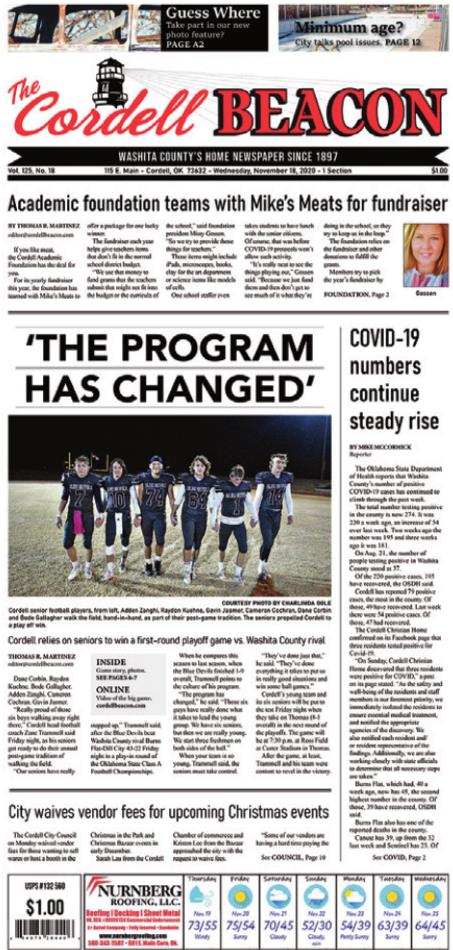
The program has changed
Cordell relies on seniors to win a first-round playoff game vs. Washita County rival
Dane Corbin. Raydon Kuehne. Bode Gallagher. Adden Zanghi. Cameron Cochran. Gavin Jasmer.
“Really proud of those six boys walking away right there,” Cordell head football coach Zane Trammell said, as his seniors got ready to do their annual post-game tradition of walking the field.
“Our seniors have really stepped up,” Trammell said, after the Blue Devils beat Washita County rival Burns Flat-Dill City 43-22 Friday night in a play-in round of the Oklahoma State Class A Football Championships.
When he compares this season to last season, when the Blue Devils finished 1-9 overall, Trammell points to the culture of his program.
“The program has changed,” he said. “Those six guys have really done what it takes to lead the young group. We have six seniors, but then we are really young. We start three freshmen on both sides of the ball.”
No. 8
Cordell Schools vs. Nurnberg Roofing
Cordell schools loses breach of contract lawsuit
In January, Washita County jury ordered Cordell Public Schools to pay more than $31,700 to Nurnberg Roofing LLC in a breach of contract case dating back almost four years. The jury ruled in favor of Nurnberg and awarded the contract amount of $31,700, plus Nurnberg’s legal fees in the dispute.
Breach of contract opens up more quesionts.
The recently-concluded Nurnberg Roofing LLC vs. Cordell Public Schools lawsuit has opened up additional questions about the school district’s contracting procedures and the board of education’s oversight of Superintendent Brad Overton.
The main issues were centered around contracting and design issues.
Update: Almost a year later, a judge ruled last week that the school district must pay Nurnberg’s legal fees in the amount of $75,000, bringing the total to $115,804.97, which includes the legal fees, interest and the original cost of the contract.
No. 7
Hospital agrees to management contract with Saints
Big changes are coming to Cordell Memorial Hospital, although hospital administration is confident the only impact of those changes on the hospital’s patients will be an improvement in the quality of care they receive. The hospital board voted to enter into a management contract with SSM Health, which owns and operates St. Anthony’s and numerous other hospitals and health care facilities in Oklahoma, as well as Illinois, Missouri, and Wisconsin. SSM Health has recently entered into a similar agreement with Weatherford Regional Hospital.
Under the terms of the agreement, SSM Health will take over the management of the hospital and current CEO Kenny Downs will step down. SSM will receive 2.75 percent of the hospital’s net revenue as a management fee.
Downs said that while he is stepping down as CEO, he might still remain with the hospital in some capacity, but right now he’s looking forward to the change.
“I’m looking forward to spending more time with my four grandkids and the rest of my family,” he said. “This is the best thing for me and for the hospital.”
No. 6 (Tie)
Cordell schools grades take significant drop
Oklahoma’s 2018-2019 school report cards are out, and the results are mixed for Cordell Public Schools. Cordell Junior High earned the same “B” grade as last year with an overall score of 68 percent, while the elementary and high schools saw significant declines in their overall scores. Cordell Elementary School’s overall score fell by 15 percentage points to end at 56 percent and the high school’s overall score dropped 16 points to 52 percent, both “C” grades. Both the elementary and high school earned “B” grades for the 2017-2018 school year.
Cordell superintendent Brad Overton attributed the decline in large part to changes in the grade calculations.
“While we see a decline in the grade for the elementary and high school sites, I believe a big part of that decline was a modification in the calculation of the grade,” he wrote in an email to The Beacon.
Cordell Water fails to meet state standards
The City of New Cordell’s water system fails to meet Oklahoma clean water standards for municipalities, according to two recent inspections of the city’s water system by the Oklahoma Department of Environmental Quality. The inspections, which took place on April 21 and April 28, were in response to citizen complaints about the city’s water quality.
On April 21, the DEQ inspector noted two primary issues with the city’s water supply. According to the report, the chlorine levels on the south side of town were not being maintained at required disinfectant levels and the water lines were not being flushed according to schedule.
Erin Hatfield, DEQ Communications Director, told the Beacon that Cordell’s water system is complex because the city draws water from two different sources, the city’s own well fields and the Foss Master Conservancy District. The city treats the well water with chlorine, but Foss uses chloramines to treat their water. The two disinfectants are not fully compatible, which results in low chlorine residuals in the system.
No. 5
‘Unfortunate:’ Ice storm leaves tree limbs, power loss in its wake
For Cindy McGuire, last week’s ice storm was a final straw – for her tree, at least.
A huge limb on her Bradford Pear tree broke off in the storm, leaving a hole in the trunk that won’t be survivable. That will leave McGuire with the task of cutting down a tree in her yard for the second time in a month. Last month’s intense windstorm finished off her other Bradford Pear tree.
“I felt like we’re very unfortunate,” she said. “The trees are not known for long life span.”
She and her husband planted the Bradford Pear trees in their yard on West Street about 15 years ago. Unfortunately, at the time, she didn’t realize the trees had shallow root systems and were so top-heavy.
“I didn’t know that when I planted it,” she said. Trees were just one aspect of the
Trees were just one aspect of the problematic ice storm last week that left city crews scrambling to keep power on for Cordell residents.
Cordell city administrator J.C. Moser said the city is proud of the job its power crew did.
They worked non-stop from 8 a.m. Tuesday morning until 5:30 a.m. Wednesday, he said.
“They had to eat on the go, and they kept going all day during the sleet and rain, working to get trees off the power lines and get the power restored,” he said.
Update: Oklahoma requested major disaster declarations for the October ice storm, that caused over $27 million to 13 counties. More than 40 counties were originally included in the declaration, but the federal government came back with the money for 13 counties. A week after the storm, more than 40,000 people statewide still were without power.
No. 4
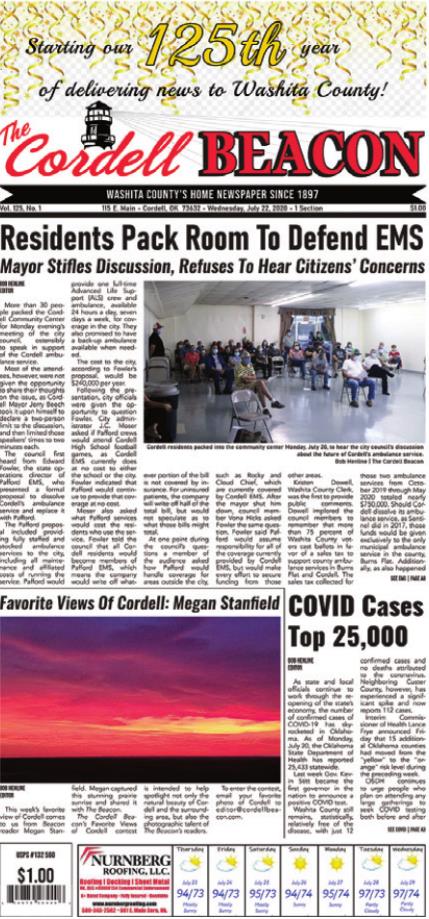
Cordell EMS issue escalates
The city’s move to possibly privatize Cordell’s ambulance service has set off a firestorm of public backlash during the past week, backlash that escalated after the mayor fired Cordell’s EMS director, Devin Humphrey.
The issue came to light during the week leading up to the Cordell City Council’s July 20 meeting. City Administrator J.C. Moser confirmed early in the week that the council would be considering a contract from Pafford EMS to privatize the city’s ambulance service.
More than 40 people packed themselves into the Cordell Community Center for the council meeting, most of whom indicated their desire to speak on behalf of keeping Cordell’s municipal ambulance service. Mayor Jerry Beech fanned the flames of the already high emotions in the room when he announced that the council would only hear from two of the people, shutting down any further discussion.
A move to privatize Cordell’s ambulance would have widespread impacts on not just the staff of the service, but also on the residents of the city, the city budget, and residents of Washita County outside of Cordell.
No. 3
Coronavirus roundup
The Coronavirus global pandemic dominated the news so much that we combined several stories into this No. 3 slot.
Washita County schools had to improvise graduations this year. The COVID-19 pandemic may have kept students out of the classrooms for the last portion of the school year, but it didn’t stop students, parents, family, and faculty from celebrating the milestone achievement of high school graduation. While the quarantine restrictions necessitated by the disease forced schools to move away from the traditional pomp and circumstance of the typical graduation ceremonies, Washita County’s high schools adapted and managed to provide unique and meaningful ways to send their graduates off in style.
The Cordell City Council implemented a mask mandate in late November. Deborah Kifer, a Cordell Memorial Hospital administrator, implored the council to pass a mask mandate during the special meeting.
“We have to do everything we can to try to minimize all of our risk on this,” she said. “All the staff, they are just begging for people to do the very best they can.”
The ordinance wasn’t unanimous: James Newman, Buddy Holman and Vona Hicks opposed the ordinance.
The schools re-opened after the summer break in a successful manner. “I think the kids at Junior High and High School also are ready to get back and see their classmates and participate in extracurricular activities,” Superintendent Brad Overton said at the time.
Meanwhile, after two weeks of near-frantic scrambling with new protocols and procedures, the Payroll Protection Program, one facet of the more than $2 trillion federal CARES Act for COVID-19 relief, has exhausted its $349 billion congressional appropriation.
While the program has received mixed reviews on the national stage, several Cordell banks successfully used to program to help their customers secure loans during the current economic crisis.
The Bank of Western Oklahoma, First National Bank, Equity Bank and the Bank of Cordell all helped businesses with the program.
“Is it a good program? Yes,” Bank of Cordell’s Chris Jones said. “It’s getting money to people who need it. Has it had some bumps along the way? Yes. But overall I would give it a thumbs up.”
Schools across Oklahoma have received funds through the CARES Act due to the ongoing Pandemic and the Cordell schools have used the money in several ways.
The Burns Flat-Dill City School District also has utilized CARES Act funds.
Cordell School Supt. Brad Overton explained the district received three different types of funding.
“The first is funds from the Coronavirus Aid Relief Act. We received $119,000. We used that to help with the salary of one person who will assist in virtual learning and we also purchased 80 new chrome books,” Overton said.
“We were able to replace a lot of our older ones. These were for grades 3-12 and we purchased several different kinds of software, too,” he added.
And businesses were happy to reopen after getting shut down early during the pandemic.
With the continued implementation of the governor’s plan to reopen Oklahoma’s economy, local eateries, gyms, and even some government offices are opening back up to the public.
Cordell’s Code Blue gym was one of the businesses to reopen their doors to the public on Monday. They had been closed since the city enacted its first emergency ordinance back in mid-March.
“Code Blue is super excited to be open again,” said owner Jason Dudgeon. “The break was nice but it’s time to get back to focusing on our community’s health and fitness. Class sizes are being adjusted and all of our athletes are working very hard to help keep everything wiped down and sprayed to keep it clean.”
No. 2
Coronavirus impacts reach Oklahoma
The coronavirus, or COVID-19, has all but monopolized nationwide and global news media in February and early March as the virus has spread from China into Europe and the United States. The reaction, both public and official, to the spread of the virus has run the gamut from disbelief to outright panic.
The President of the United States has declared a national emergency. Several state governors, including Gov. Kevin Stitt of Oklahoma, have followed suit and declared emergencies in their states. But what does that really mean in the day-today lives of Oklahomans?
A declaration of emergency, be it at the municipal, state, or federal level, is not a sign that it’s time to push the panic button. The overwhelming majority of emergency declarations, including ones related to COVID-19, are procedural; they trigger the release of resources reserved for emergency and the implementation of laws specifc to emergency situations.
At the federal level, that means funding. The U.S. Department of Health and Human Services is currently in the process of allocating funds to various state agencies to help curb the spread of the virus and to treat those impacted. The Department of Commerce is rolling out various stimulus programs to help businesses impacted by the virus. At this point, it is still unclear exactly how those stimulus dollars will be allocated, but a small business loan program is already in place. Up-to-date information is available through the Oklahoma Department of Emergency Management.
At the state level, Gov. Stitt’s declaration makes Oklahoma’s 77 counties eligible to receive both state and federal support. It also allows state agencies to make emergency purchases of materials and supplies needed to combat the spread of the virus and allows small businesses to apply for emergency low-interest loans.
No. 1
First wave of vaccines set to hit
After dealing with COVID-19 impact for most of the year, it was nice to get some good news in the fight against the deadly virus.
Oklahoma’s frontline health care workers received a good dose of COVID-19 news when the state announced the upcoming arrivals of a vaccine to fight the virus.
The state was slated to receive about 43,000 doses initially, 33,000 from Pfizer and 10,000 from Moderno, between Dec. 11-14. The initial vaccines will go to people who are classified in the first phase of the state’s distribution plan.
Those include public health staff, long-term care staff and residents and health care workers working directly with inpatient COVID-19 care. The state estimates about 115,000 people are classified in the first phase.
“We want to make it clear,” Col. Lance Frye, the state’s Commissioner of Health, said. “This does not mean the general public will have access to the vaccine at that time. Those initial doses will go to our phase one people, which are the most at-risk population that are on the front lines.”
The state will receive additional vaccines every one to two weeks, Frye added.
In Cordell, vaccinations went first to hospital staff about two weeks after the initial doses hit the state.
Deborah Kifer, Memorial Hosital administrator, said the hospital didn’t mandate that staffers receive the vaccination.
“As the COVID-19 vaccine is made available, employees will not be required to receive the twodose vaccine at this time,” Kifer said. “However, with a reported efficacy rate above 90%, we do encourage employees, especially those at the bedside, to receive the vaccine to keep themselves safe and help prevent the spread of the virus.”
Dr. Bob Abernathy was the first health-care professional to receive the vaccine in Washita County. He received his dose on Dec. 21.