
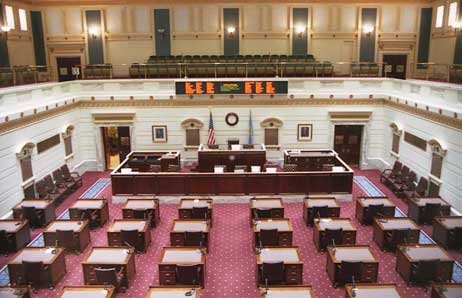
Our Oklahoma Legislature has been very busy this year, signing over 350 new laws in 2021 with several going into effect as of November 1. That is almost 300 more than what our Legislature enacted in 2020 due to the Covid-19 pandemic.
Here is a recap of a few of the new statues. You can see a complete list at www.oklegislature.gov.
Health
-HB 1006 creates the Transparency in Health Care Prices Act. The measure requires each health care provider and facility to publicize the most common health care services electronically or via their website. Health care facilities are also required to make common diagnosis and outpatient CPT codes public. The price list must be updated annually
-HB1019 caps the co-pay for a 30-day supply of insulin at $30.
-HB2687, the ‘No Patient Left Alone Act’, provides certain visitation rights, policies and safety protocols for minors and adults while in hospital.
Education
-HB1046 requires school districts to post a copy or hyperlink of their most recent financial audit to their website.
-HB 1568, Maria’s Law, requires that all schools, as part of any health education curriculum, include instruction in mental health, with an emphasis on the interrelation of physical and mental well-being beginning in the 2022-2023 school year.
-HB2030 will require high school students to pass a citizenship test in order to graduate. This is the same test that immigrants must pass to become a United States Citizen and the new law will require 60 percent or higher on the 100-question exam.
-SB252 will require all public and charter schools to offer students at least one computer science course by the 2024-2025 school year.
Alcoholic Beverages
-HB 2380 allows alcoholic beverage licensees to provide self-pour automated devices for dispensing beer and wine. In order for a patron to use the self-pour service, they must obtain an RFID device or other ABLE Commission-approved technology from the licensee, which will give the patron a credit to dispense 10 ounces of wine or 32 ounces of beer.
-SB385 The measure authorizes retail spirit, wine, or beer licensees to host tasting events and provides regulations for such events.
-SB 646 allows an employee of an establishment that sells alcoholic beverages to carry or possess a weapon while in the scope and course of employment if the employee has permission from the owner.
Business
-HB 1001 creates the ‘Sergeant Craig Johnson Metal Theft Act’ and clarifies the data required to be maintained by a scrap metal dealer. The measure provides that any federally recognized identification card can be used and requires a vehicle identification number to be recorded if no license plate is affixed. Items purchased by a buyer or sold by a dealer must be captured digitally and re cords of the transaction must be maintained for at least 2 years after the date of sale
Medical Marijuana
-HB2646 adds several pieces into law such as providing a 3 day license to non-resident patients, allowing dispensaries and commercial growers to make and sell pre-rolled joints, prohibit physical handling of medical marijuana with exceptions, and twice-yearly inspections of processing operations.
Courts
-HB 1310 creates the Sarah Stitt Act and directs the Department of Corrections to coordinate with the Department of Public Safety to provide REAL ID Noncompliant Identification Cards to all offenders, who do not have a current state-issued identification card or driver license, upon their release.
-HB 1643 creates a crime for doxing a peace officer or public official that creates a reasonable fear of death or serious bodily injury. The crime is a misdemeanor punishable by up to 6 months in the county jail, a fine of up to $1,000 or both fine and imprisonment. Punishment for a second or subsequent offense is up to 1 year in the county jail, a fine of up to $2,000 or both fine and imprisonment. The measure provides definitions. The measure allows elected county officials and peace officers to request that the county assessor not make information available on the internet.
-HB 2295 provides that a person arrested for the violation of a protective order, an act of domestic violence, domestic abuse, stalking or harassment shall not be eligible for a personal recognizance bond.
-HB 2318 modifies rules on the termination of parental rights to include any findings of heinous or shocking child abuse or neglect or failing to protect any child from heinous or shocking abuse or neglect as legal grounds for the termination of parental rights.
-HB 2546 creates the “Sexual Assault Victims’ Right to Information Act”. The measure provides definitions and provides that a sexual assault victim retains all the rights of this act regardless of whether the victim agrees to participate in the criminal justice system at any time and regardless of whether the victim agrees to receive a medical evidentiary examination to collect sexual assault forensic evidence. The bill provides that a sexual assault victim has a right to consult with a sexual assault advocate during any examination or interview. A sexual assault victims’ advocate may be present during any interview with law enforcement or district attorney. The measure provides that no sexual assault forensic evidence can be used to prosecute a sexual assault victim for any misdemeanor crime or as a basis to search for further evidence of any unrelated misdemeanor crime that may have been committed by the victim.
-HB 2774 requires all law enforcement agencies, sheriffs, jailers, prison keepers, and their deputies who have custody of a person who is the subject of an immigration detainer request to comply with any request made in the immigration detainer request provided by the federal government and to inform persons identified in the immigration detainer request that they are being held as a result of the request.
-SB 17 specifies that an officer conducting a lethality assessment on a potential domestic abuse victim must implement the protocol referral process to a domestic violence advocate from a certified or tribal program in a manner outlined in the measure. Regardless of the results of the lethality assessment, referral information for shelters, domestic violence programs and other social services must be provided to the victim.
-SB 87 authorizes a person in possession of a controlled dangerous substance as defined by Oklahoma law, who appears to be in need of help and consents to the offered help, in lieu of arrest, may be taken to an approved treatment center or an approved center for substance abuse evaluation by a law enforcement officer.
-SB 200 authorizes a victim of domestic violence, sexual violence, or stalking to terminate a lease without penalty by providing written notice and either a protective order or a police report of an incident of the violent event within 30 days of the incident to his or her landlord. The measure also provides for the perpetrator to be held civilly liable for any economic loss incurred by the landlord as a result of the early lease termination.
-SB 320 provides for the “medically frail” and “medically vulnerable” as defined in the measure to receive consideration in compassionate parole proceedings. The measure defines medically frail as it relates to medical parole to mean an individual with a medical condition which precludes the individual from performing two or more activities of daily living on their own. The measure also defines medically vulnerable as an individual with 1 or more medical conditions which makes the individual more likely to contract an illness or disease while incarcerated that could lead to death or cause an individual to become medically frail
Other
-SB272 requires a wireless telecommunications carrier, upon request of law enforcement, to provide call location information in order to respond to a call for emergency services, or in an emergency situation that involves risk of death or serious physical harm
-HB2873 creates the “Universal Licensing Recognition Act”. The measure provides that a person moving to Oklahoma would be able to apply for licensing or certification for an occupation with a similar scope of practice, and the applicant supplies verifiable proof of physical residency in the state or is married to and accompanying an active-duty member of the Armed Forces to an official permanent change of station to a military installation located in the state.
-HB1816, This act shall be known and may be cited as “Cali’s Law”. The rescue animal is hereby designated and adopted as the state pet of the State of Oklahoma. As used in this section, “rescue animal” shall mean any companion animal adopted from an animal shelter licensed pursuant to the Commercial Pet Breeders and Animal Shelter Licensing Act or animal welfare or rescue organization that facilitates the adoption or housing of companion animals with the intention of finding permanent adoptive homes or providing lifelong care for companion animals.
-SB 172 creates “Ida’s Law” and directs the Oklahoma State Bureau of Investigation (OSBI) to coordinate with the United States Attorney’s Office and the United States Department of Justice to obtain federal funding no later than January 1, 2022, for the purpose of gathering data to address the issue of missing and murdered indigenous persons. The measure creates the Office of Liaison for Missing and Murdered Indigenous Persons under the OSBI. The newly created Office is to work with tribal, state, and federal authorities on missing persons and homicide cases, provide guidance to victims’ families, facilitate training and promote best practices, and consult with community organizations to promote community relations.