

I am always a fan of documentaries about nature and anything plant related. Recently I stumbled upon ‘Fantastic Fungi’ on Netflix. This film directed by Louie Schwartzberg is a must watch for all of my gardening friends that want to know more about the benefits of fungi and mushrooms.
After watching this great documentary, I am even more interested in mushrooms and the health benefits they can provide to my gardens and my own health.
I have previously written about mushrooms being a good sign in the garden and would like to elaborate more on what they really do represent in nature.
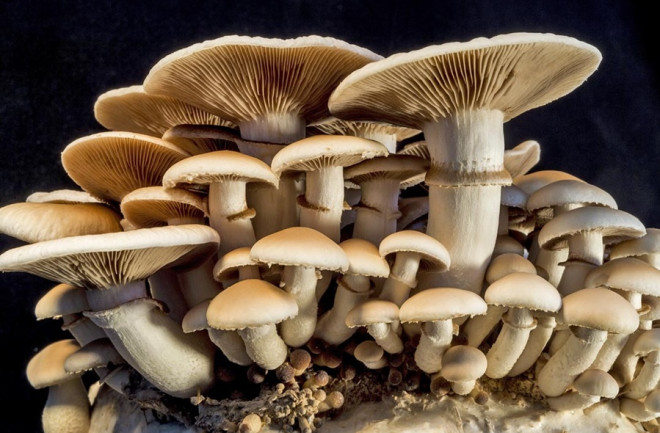
A mushroom is the reproductive structure of some fungi. Mushrooms grow in a wide variety of shapes, sizes, and colors. They are the most common species of fungi and can be found growing everywhere around us.
Similar to a fruit except that the ‘seeds’ it produces is actually millions of microscopic spores that form in the gills underneath the mushroom’s cap.
The spores are lightweight gene-carrying systems that can be spread easily in the wind or by other means such as feeding animals.
As spores are released, they search for a suitable food source, such as wood or soil. Once the spores find their idea habitat, they will germinate to form a network of microscopic rooting threads called mycelium.
Mycelium penetrates into this new food source, often for several years, extracting nutrients and sending up its annual crop of mushrooms.
Mycelium has more networks than our brain has neural pathways and works the same way with electrolytes (electrical pulses). Mycelium can have trillions of end branching threads. Studies have begun to show that trees and plants can actually communicate using mycelium.
They use the mycelium as a pathway to feed one another by swapping nutrients from one tree to another. Mother trees can recognize their own seedlings and can send signals to each other through the mycelium network. The mycelium carries carbon between the trees while supporting the weaker ones
. If detrimental pests are around a tree will increase its competitive environment towards its own seedlings so that the seedlings will grow farther away for safety. Mycelium can theoretically live forever if it has food to grow into.
Plants photosynthesize CO2. As the plants pull carbon from the atmosphere, they put it in many places like their leaves, stems, and trunks.
However, it has been found that plants actually put 70% of that carbon (acquired through photosynthesis) below ground. The mycelium root systems trade that carbon for nutrients that the plants need. A single fungal network can be connected to many plants and can become a route between plants to supply needed nutrients.
It is much like an underground tree of life. The fungi are really important in stabilizing carbon in soils. Once the carbon is stable it can stay there stored for thousands of years.
Fungi, such as mushrooms, mold, and yeast are a member of the group of eukaryotic organisms. Fungus is its own kingdom altogether
. The Fungi kingdom is closely related to the human species but lies somewhere between us and vegetables.. It is estimated that there are between 2.2-3.8 million species of fungi. Only 120k have been documented and described.
About 20k of those species produce mushrooms, the flowering body of Fungi. Living creatures like Fungi are intelligent in the sense that they respond to their environment, they seek out food and they defend themselves.
Without fungi we would get plant build up that would choke out the earth. They break down plant life and make it usable for new plant life and for animal life. Fungi are the grand molecular decomposers of nature. Fungi decompose dead and dying organisms as they recycle the nutrients back into the earth
Saprobes are the group of fungi that act as decomposers, feeding on anything that is hydrocarbon based. The mold that makes beer, cheese and wine are saprobes. Fungi is one of the oldest living organisms on Earth and it is also the largest.
Discovered in 1998, Armillaria ostoyae occupies some 2,384 acres of soil in Oregon’s Blue Mountains. Based on its current growth rate, the fungus is estimated to be 2400 years old and could be as ancient as 8650 years old.
A combination of good genes and a stable environment has allowed this massive fungus to continue its creeping existence over this long period of time.
All fungi in the Armillaria genus are known as honey mushrooms for the yellow capped sweet fruiting bodies they produce.
Fungi have been around longer than most species. A fossilized specimen of fungi was collected in Canada’s Arctic by an international team and later identified to be the oldest fungi ever found, sitting somewhere between 900 million and 1 billion years old.
Mushrooms seem to correct everything on earth. They support life, they convert life, they carry life. They are remarkable organisms.
As they may represent death and decay to several people, more and more research has found that there are several health benefits that we can achieve with mushrooms.
I plan on doing a lot more research and experimentation with fungi so that I can learn how to grow edible mushrooms purposely in my own backyard.
It looks like fungi is more amazing for my soil and plant life than I have ever given it credit for.
Charla Ingram is a plant, nature and golfing enthusiast who, along with her husband Chris, owns and operates C&C Garden in the small town of Bessie, Oklahoma.