
Say you have a patch of land that’s been more of a headache than a payoff. Some years, you farm it. Some years, you don’t. The soil is thin, the yields are low and the math never quite works out.
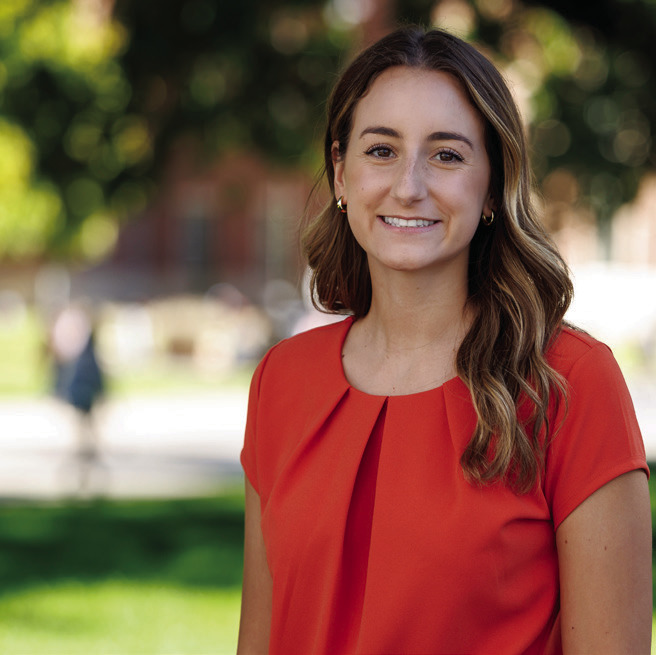
What if you just planted trees instead? That is the question driving Sydney Vieira’s master’s thesis research at Oklahoma State University. Vieira, who is graduating with her degree in agricultural economics in May, has spent the past year creating a model to determine whether planting loblolly pine on marginal land in eastern Oklahoma is financially viable for landowners and whether access to carbon markets could make the numbers work even better.
“If a landowner thinks they have less productive land, there are other options that could benefit them economically in the right conditions and benefit the environment,” Vieira said.
Marginal land is acreage that cycles in and out of cultivation every few years, never quite productive enough to farm consistently but not abandoned either. In eastern Oklahoma, this type of land is common.
Vieira’s thesis is part of a larger USDA-funded project led by Omkar Joshi, a professor in the OSU Department of Natural Resource Ecology and Management, that spans forestry, economics, supply chains and social science. The team is asking whether carbon-based forest management on marginal lands and improved forest management in existing marginal forested lands can realistically work in Oklahoma, and what it would take to get there.
Her team’s hypothesis: Instead of coaxing unreliable harvests from difficult ground, what if landowners grew timber? Eastern Oklahoma gets enough rainfall that loblolly pine, a commercially valuable species common in the South, could grow reasonably well.
The western half of the state is a different story. “Trees grow faster in the eastern part. That’s why there’s already commercial timberland there. You need growth fast enough to generate revenue that offsets your investment,” Joshi said.
Using the Forest Vegetation Simulator, a computer modeling program developed by the U.S. Forest Service, Vieira can project timber growth across dozens of landquality scenarios without waiting a quarter-century for results.
“I tell [the application] the tree species, how many trees per acre we’re planting and where, and it tells me how much timber is being produced every five years,” she said. “If I make a mistake, I fix it and rerun the simulation in about 60 seconds.”
Since marginal land encompasses diverse soil qualities and site conditions, Vieira runs multiple scenarios simultaneously, adjusting variables like land productivity, timber prices and interest rates to observe how the results change.
“We want to generate information, so a landowner can look at their specific situation and say, ‘at this timber price on land like mine, here is what the economics actually look like,’” said Lixia Lambert, an assistant professor in the OSU Department of Agricultural Economics and Vieira’s faculty advisor.
Currently, timber-only scenarios are not profitable because Oklahoma pulpwood prices are modest, and the land is not highly productive. Additionally, those same acres could be rented to ranchers for cattle grazing. This potential income loss needs to be factored in when evaluating the option of planting trees.
“Think about growing corn on very bad land without much water. Your yield is low, but your planting cost is the same. That is the core problem here,” Lambert said.
“If it were super profitable, everyone would already be planting trees,” Vieira added, emphasizing that a negative result is not a failure but rather an answer. This answer suggests something potentially more interesting – carbon.
When Vieira adds carbon payment scenarios to her models, the profit margin improves.
As trees grow, they absorb carbon dioxide from the atmosphere and store it, and that stored carbon has market value. Large corporations looking to offset their emissions pay landowners who can demonstrate carbon sequestration on their property.
“The break-even carbon price in our scenarios could be under $100 per ton,” Lambert said. “That sounds high until you consider what carbon emissions actually cost society.”
Joshi said he sees a connection to one of the state’s most visible problems – wildfire. Eastern red cedar has been spreading aggressively across Oklahoma for decades, crowding grasslands and building as a fuel source. Improved forest management could reduce that risk while generating income for landowners. Healthy, actively managed forests also support hunting and recreation.
“We need a market-based solution,” Joshi said. If a landowner sees real economic opportunity in managing their forest, they will be motivated to do active management.”
Improved forest management already aligns with landowners’ existing goals. Future research could explore supply chain logistics and whether Oklahoma landowners would be willing to participate.
“We’re not saying what landowners are doing now is wrong,” Lambert said. “We’re saying consider something else. The purpose of our research is to provide more information and education, so it is not as scary to think about switching from one land use to another.”