
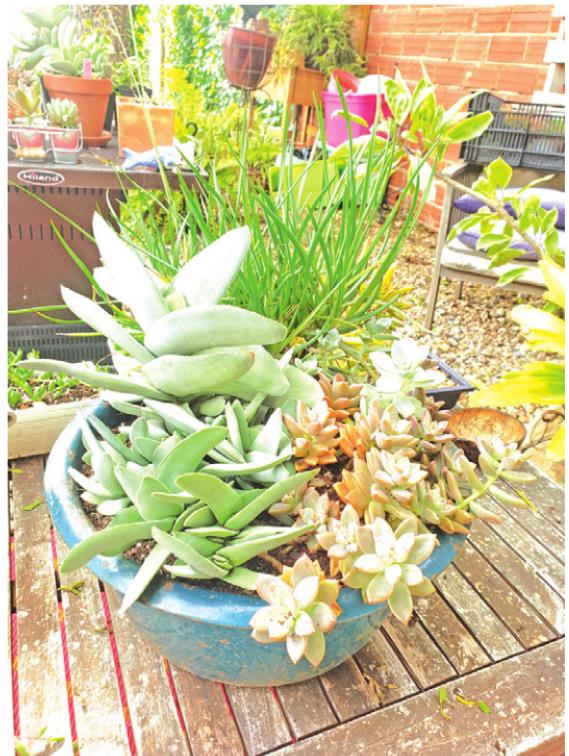
Container gardening is ideal for those with little or no garden space, poor soil compilation, poor drainage or other variables that hinder inground gardening. It also adds versatility to gardens large and small. Container gardens can create instant color, provide a focal point in the garden, or tie in the architecture of the house to the garden. Containers can be placed on the ground, on a pedestal, hung over fence railing, secured to windowsills, hung under your favorite tree, or placed wherever your heart so desires.
Containers come in a wide variety of materials, shapes, and sizes. You can choose to get earthtoned containers that blend into the landscape. You can choose bold and bright colors to make them stand out. You can turn scrap materials into containers or even create your own with natural materials collected around the yard. As long as the container has proper drainage and enough room to supply your plant’s soil and water needs, you can turn just about anything into a gardening container. Here are some quick tidbits on the different types of containers: Terra Cotta, a porous material that allows air and moisture to move through its walls, thus keeping the soil drier than others - Perfect for succulents and plants that prefer to be dry. Concrete, very heavy but has insulated walls that will keep soil at a more consistent temperature – Still porous so the soil may dry out faster than expected. Plastic, lightweight and inexpensive – Best to use dark colored pots in shaded areas as these pots will warm up fast and could damage roots when in Full sun. Resin, lightweight and textured to replicate many other materials – Rated Best above other materials, IN resin is lightweight, durable and insulates well. Metal, easily accessible but can heat up and burn roots if placed in direct sun during summer months- rust can have adverse effects on plants, using a plastic liner inside the container can be beneficial. Wood, inexpensive and easily customizable-will break down over time.
Drainage is particularly important for any container grown plant. If your container does not have proper drainage, the plants will become waterlogged and the roots will rot. If your container does not have drainage holes, it is a simple process to drill some provided you have a drill and the proper drill bit made to drill into the container’s material. A basic drill bit will drill through wood, plastic, fiberglass, and resin containers. A Masonry drill bit will be needed to drill through clay and non-glazed ceramic. A glass or tile bit will be needed to drill through glazed ceramic pots.
Soil is a key ingredient in proper container gardening. Garden soil does not offer adequate air, moisture or nutrients to container grown plants. You can amend your garden soil by mixing equal parts of garden soil with perlite or vermiculite, and sphagnum moss. Other additives you can include would be pine bark or pine fines (better aeration for trees and tropical plants), coconut coir and coarse sand (a great additive for plants that require fast drainage). Readymade potting soils are a great alternative to amending your garden soil. The key to finding a good potting mix is to make sure the mix is fluffy and lightweight. Heavy mixes tend to be slower draining and can clump up around your plant’s roots.
When planting your containers, you can choose to plant a single specimen or a combination of plants. Generally, combination pots are composed of ‘A Thriller, A Filler and A Spiller’. ‘The Thriller’ should be a plant that adds height and/or captures the attention of the overall container. This is usually a single specimen or a selected grouping of plants that are planted close together and are generally the tallest of the plants in the combination. ‘The Filler’ is a group of plants shorter and wider than ‘The Thriller’ that will eventually fill in the space in the middle of your container. ‘The Spiller’ will be plants that lay over the edge of your container to hide the voided space between the edge of the container and soil line.
Light requirements will need to be similar within the plantings you chose for your containers. If you are placing your container in Full Sun, be sure to use plants that all require Full Sun. Full Sun plants typically need 6-8 hours of direct sunlight. Partial Sun plants typically need 3-6 hours of direct sun and partial shade plants usually need 3-6 hours of sun to bright dappled shade. Keep in mind that during our Western Oklahoma Summer months, about 95 degrees and higher, plants will be happier in a more dappled sun than in direct scorching sunlight at this time.
Once you have your containers planted it is important to develop a watering and fertilizing schedule. Keep in mind that containers will dry out faster than the ground since the water is passing through a limited amount of space. It is best to measure the dryness of your container’s soil by placing your finger into the dirt and feel for moisture about 1 inch below the soil line. I water my containers every 3-5 days during spring and increase that to daily when temperatures soar above 95 in the summer. If your container seems to be holding too much water, you may have to increase its drainage or further amend the soil. Began fertilizing your plants in containers around 2-4 weeks after you plant them to ensure they have the proper nutrients to grow. All-purpose fertilizers have nitrogen, potassium and phosphorus, nutrients plants need in large amounts, as well as other essential plant nutrients like iron, manganese, and zinc. To promote flower or fruit production, select fertilizers with higher amounts of phosphorus or potassium relative to nitrogen, such as tomato food or bloom boosting fertilizer. Generally, I fertilize every 2-3 weeks when I am using a water-soluble fertilizer.
Charla Ingram is a plant, nature, and golfing enthusiast who, along with her husband Chris, owns and operates C&C Gardens in the small town of Bessie, Oklahoma.